
Key Takeaways
- The real UK dental challenge: Many patients are not seeking treatment abroad for a bargain—they are responding to difficult NHS access, delayed care and private restorative quotes that can reach £15,000–£30,000 or more for complex implant cases.england.
- Implants are usually a private decision: Routine NHS dentistry does not generally fund dental implants for typical tooth-loss cases, meaning people with missing teeth often need to consider private treatment options.
- Budapest can offer meaningful savings: Depending on treatment complexity, patients may pay around 35%–65% less for implant, crown and full-arch restorative treatment in Budapest before accommodation and travel costs.
- Clinical planning must come before price: A responsible implant clinic should review X-rays, medical history, gum health, bite forces and bone availability before confirming a final treatment plan.
- Not every patient needs “teeth in a day”: Immediate-load implants can suit selected cases, but many patients benefit from a staged approach that allows implants to heal for around 3–6 months before the final bridge or crown is fitted.
- Budapest is not the same as a cosmetic package destination: The city has a long-established reputation for oral surgery, implantology, restorative dentistry and dental laboratory work, with clinics often treating UK, Irish and European patients.
- Traceable implant systems matter: Ask exactly which implant system will be used and request an implant passport or treatment record. Established systems such as Straumann and Alpha-Bio can make future component identification and maintenance easier.
- A two-hour flight can make staged care manageable: Direct routes from major UK airports generally make Budapest accessible for an initial surgical trip and a later visit for final crowns or fixed bridges.
- Aftercare needs planning before travel: Ask for a written warranty, a full treatment summary, imaging records, implant details and a clear protocol for hygiene, reviews and urgent concerns after returning to the UK.
- The best next step is an itemised second opinion: Send your UK dentist’s treatment plan, panoramic X-ray or CBCT report to a reputable Budapest clinic to compare the clinical options, expected timeline and total treatment cost before you book.
Budapest Dental Implants vs the UK: A Reassuring Guide for British Patients
For many UK patients, the decision to seek dental treatment abroad is not driven by a desire for a “cheap smile.” It begins with a far more personal problem: a missing tooth that makes eating difficult, a failing bridge, painful dentures, repeated repairs, or a private treatment estimate that reaches £15,000, £20,000 or even £30,000.
As a Budapest oral-surgery clinician, I speak with British patients every week who have delayed essential restorative care for years. They are not looking for shortcuts. They want a safe, clinically sound way to restore function, confidence and comfort—without accepting an unaffordable financial burden. For carefully assessed patients, Budapest can offer that balance: specialist-led implant dentistry, recognised implant systems, EU-regulated clinical standards and a clear treatment pathway within a short flight from the UK.
The UK dental access problem
The UK dental crisis is not simply a headline. It is an access, affordability and timing problem that affects patients differently depending on where they live, whether they can find an NHS practice accepting new patients, and whether they can afford private treatment.
NHS dentistry remains important and provides valuable care for millions of people. However, it does not routinely provide implant treatment except in narrowly defined clinical circumstances, such as some major trauma, congenital conditions or cancer-related reconstruction. For the typical patient with a missing molar, an old bridge, loose dentures or multiple failing teeth, implant-based rehabilitation is generally a private treatment decision.
That leaves many people caught between two difficult options:
- Wait for available NHS assessment and treatment for routine dental needs, often facing local capacity constraints.
- Pay privately in the UK for advanced restorative dentistry, where multi-implant treatment can become financially overwhelming.
NHS England’s own analysis found that the Dental Recovery Plan did not achieve its intended step-change in access during 2024/25. New patients seen per working day declined by 5%, with adult new patients declining by 8% during the period examined. The analysis also showed that adult NHS dental access remained substantially below pre-pandemic levels.
This does not mean every UK patient faces the same delay. Some practices can offer appointments quickly, while others have long waiting lists or are unable to take new adult NHS patients at all. But the wider picture explains why so many people feel they have been left with no realistic route to timely, advanced restorative treatment.
In the 24 months to March 2025, NHS England data showed around 18.1 million unique adult patients had been seen, compared with approximately 21.7 million in the comparable pre-pandemic period ending April 2019. That is a major gap in access, even though NHS activity has gradually recovered.
For patients requiring implants, there is a second issue: availability is not the same as suitability. An NHS appointment may help identify decay, gum disease, infection or urgent pain, but it does not usually lead to implant treatment. A person may therefore be able to obtain emergency care, yet still have no practical NHS route to replacing a missing tooth with a fixed implant-supported restoration.
Why waiting changes the clinical picture
Delaying treatment is understandable when a patient is worried about cost. However, missing teeth and failing dental work can become more complicated over time.
After a tooth is lost, the surrounding bone may gradually reduce in volume. Adjacent teeth can drift or tip into the gap, the opposing tooth can over-erupt, and bite forces may become uneven. Where several teeth are missing, patients may start chewing predominantly on one side, avoiding social meals or relying on softer foods.
A delayed case is not automatically a failed case. Many patients can still be treated successfully years after tooth loss. But a previously straightforward single implant may eventually require additional procedures such as bone grafting, sinus elevation, gum treatment or more complex prosthetic planning.
This is why a proper assessment matters. A reputable implant clinic should never make a final promise from a photograph alone. A panoramic X-ray may help with an initial screening, but complex implant planning normally requires clinical examination and, where appropriate, a CBCT scan to assess bone dimensions, anatomical structures and prosthetic space.
The private-cost reality
Private dentistry in the UK can provide exceptional care. The question for many patients is not whether good UK clinicians exist—they do—but whether a full treatment plan is financially achievable.
A single implant with its final crown commonly costs several thousand pounds in UK private practice. Costs vary substantially by region, the clinician’s experience, implant system, imaging requirements, bone grafting needs, sedation, laboratory work and the complexity of the final restoration. Current UK price guides commonly place a completed single implant and crown in the broad £2,000–£5,500 range, with implants rarely available through routine NHS care.
For a patient who needs a full arch restoration, the numbers rise quickly. A fixed full-arch implant bridge may involve extractions, temporary teeth, four to six implants, surgical care, laboratory fees, a provisional restoration, a definitive bridge and multiple reviews. In many UK private settings, treatment can reasonably enter the £15,000–£30,000+ range depending on the case, materials and whether one or both arches require rehabilitation.
The issue is not that UK private fees are inherently unreasonable. Clinics face high operating costs, staffing costs, laboratory fees, property costs, insurance requirements and the clinical time needed for complex cases. But patients facing large treatment plans still need an affordable, transparent alternative.
That is where Budapest has built a reputation over several decades—not as a destination for rushed cosmetic makeovers, but as a European centre for restorative dentistry, oral surgery, implantology and dental laboratory craftsmanship.
Why Budapest is different
Budapest is often grouped together with every other overseas dental destination. That is a mistake. Countries, clinics, materials, regulations, treatment philosophies and aftercare systems vary enormously.
The most useful question is not, “Is dentistry abroad safe?” The right question is: “Is this specific clinic, clinician and treatment plan appropriate for my case?”
Budapest has a long history of treating international dental patients, particularly from the UK, Ireland, Germany, Austria and Scandinavia. Hungary developed a strong reputation in restorative dentistry partly because of its dental education, clinical workforce, specialist experience and established dental-laboratory sector.
For patients with missing teeth, extensive failing dentistry or complex bite problems, the objective should be functional rehabilitation—not simply a fast cosmetic result.
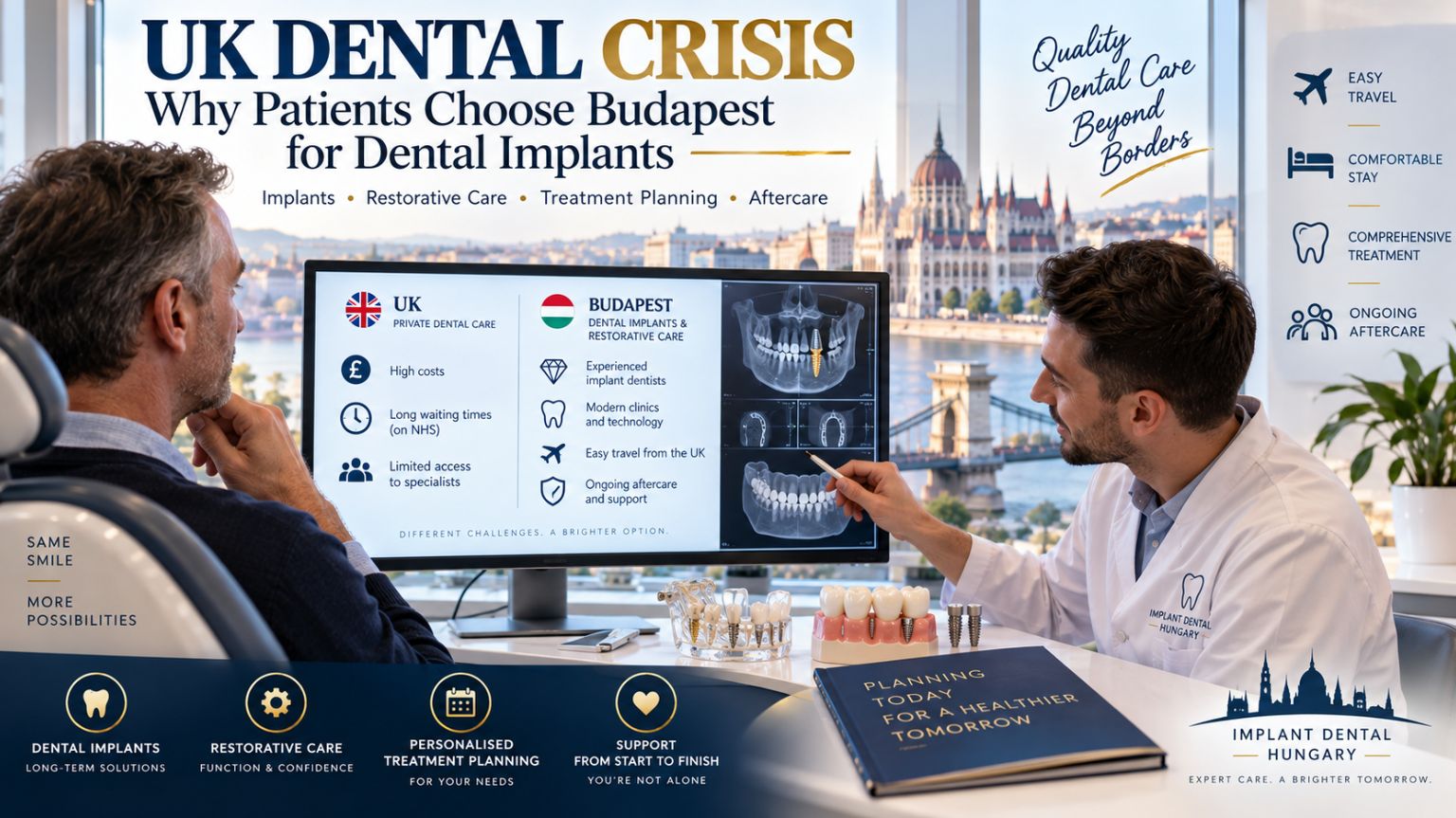
Budapest versus high-volume cosmetic destinations
Turkey remains highly visible in dental tourism marketing, particularly for veneer packages and rapid cosmetic transformations. There are excellent dentists in Turkey, just as there are poorly planned treatments in every country. The point is not to label an entire destination as good or bad.
However, UK patients should understand the different treatment cultures they may encounter.
The distinction is important because implants and full-mouth restorations are not holiday purchases. A successful outcome depends on more than placing implants. It requires diagnosis, appropriate surgical positioning, gum and bone management, bite design, stable temporary teeth where needed, high-quality laboratory work and long-term maintenance.
An experienced Budapest oral-surgery team will usually discuss questions that may be missing from a “teeth in Turkey” style package advertisement:
- Are your gums stable enough for implants?
- Do you grind or clench your teeth?
- Is there sufficient bone for immediate implants?
- Will you need grafting or sinus work?
- Is immediate loading clinically appropriate, or should treatment be staged?
- What will happen if a tooth is found to be unsuitable after examination?
- Which implant brand and component system will be used?
- How will the bite be checked before final zirconia or ceramic work is fitted?
- What aftercare is realistic once you are back in the UK?
If a clinic does not ask these questions, it is difficult to know whether it is truly planning treatment around your biology and needs.
What treatment costs can look like
The following comparison is intended as a realistic guide, not a guaranteed quotation. Every patient is different. Bone grafting, extractions, gum treatment, sedation, temporary teeth, CBCT imaging, sinus elevation, additional implants and material upgrades can all change the final fee.
A trustworthy clinic should provide an itemised plan that separates surgical, restorative and optional costs before you book travel.
UK price guides show a completed single implant commonly falls within a broad private range of roughly £2,000–£5,500, while full-mouth reconstruction can exceed £20,000. Budapest pricing varies by clinic and material, so patients should treat any “from” price as a starting point—not a final medical quotation.
The real value of travelling is not simply the headline saving. It is the opportunity to receive a carefully planned treatment at a more manageable total cost while still using established implant systems and quality restorative materials.
A lower price is worthwhile only when the treatment plan remains clinically appropriate.
Implant systems and material traceability
Patients often ask whether they will be able to obtain help in the UK if a crown, screw or implant component needs attention in the future. This is a sensible question, and it should be asked before treatment starts.
A well-organised implant clinic should provide:
- The implant passport or equivalent documentation.
- The manufacturer and system name for each implant.
- Implant dimensions and site positions where available.
- Details of the abutment and restorative components.
- Copies of relevant X-rays, CBCT reports and treatment summaries.
- Information about crown or bridge materials.
- Instructions for hygiene, maintenance and emergency contact.
Straumann is a widely recognised premium implant manufacturer with a broad international professional network. Alpha-Bio is also an established implant system used internationally. Neither brand alone guarantees a successful result; surgical planning, restorative design, gum health, patient habits and maintenance remain crucial. But using traceable, internationally distributed systems can make it easier for another clinician to identify compatible components if future support is required.
Be cautious if the clinic will not disclose the implant brand, cannot provide documentation, or uses vague wording such as “German implants” without naming the manufacturer and model. Dentistry should be transparent. You are entitled to know what has been placed in your body.
The journey from the UK
Budapest is accessible from major UK airports with direct flights typically taking around two to two and a half hours, depending on the departure city and routing. That makes it practical for staged implant treatment, especially for patients who cannot justify repeated long-haul travel.
The travel side should feel organised rather than stressful. A patient-focused clinic can coordinate the practical details that make a medical trip less daunting:
- Airport pickup and return transfer.
- English-speaking patient coordination.
- Assistance choosing accommodation near the clinic.
- A written itinerary with appointment times.
- Medication and post-operative instructions in English.
- A direct point of contact for questions during the stay.
- Clear advice about when it is safe to fly after surgery.
For many procedures, patients should plan to stay long enough for post-operative checks rather than booking a flight home immediately after surgery. The exact timing depends on the procedure, your medical history and your surgeon’s assessment.
Typical staged timelines
A reliable treatment plan explains the timeline honestly. Fast treatment is not always better treatment.
Immediate-load or “teeth in a day” protocols can be appropriate in selected full-arch cases. But they are not a universal solution. The surgeon must assess implant stability, bone quality, bite forces, infection risk and whether the provisional restoration can be protected during healing.
A patient who needs grafting or has active gum disease may need a slower, staged protocol. That is not bad news. It is often the safer route to a durable result.
Aftercare, complications and warranties
The biggest fear many UK patients have is straightforward: “What happens if something goes wrong when I get home?”
This concern deserves a direct answer. Implant and restorative dentistry carry risks wherever they are performed. Possible issues include infection, delayed healing, implant failure to integrate, gum recession, chipping, loosening of a screw, bite discomfort, fracture of a temporary restoration or failure of an existing tooth that was retained as part of the plan.
No ethical clinic can promise that complications will never occur. What it can do is establish a responsible process before treatment starts.
What a credible warranty should cover
A written warranty should state clearly:
- Which components are covered: implant, crown, bridge framework, veneer or laboratory work.
- The warranty duration for each part.
- What clinical conditions apply, including hygiene attendance and regular reviews.
- Whether damage caused by trauma, bruxism, smoking, untreated gum disease or failure to wear a prescribed night guard is excluded.
- Whether travel costs are included or excluded.
- What happens if a component fails in the UK.
- Whether the clinic covers repair, replacement, laboratory work or clinical fees.
- How a patient can report a problem and share photographs or X-rays.
A warranty is not a substitute for maintenance. Implants can develop peri-implant disease if plaque control is poor, smoking continues, diabetes is uncontrolled or professional maintenance is neglected. A ceramic bridge can chip under severe grinding forces. Natural teeth supporting other parts of the bite can also change over time.
The most responsible approach combines a warranty with a written UK follow-up protocol.
Your UK follow-up plan
Before travelling, ask whether your current UK dentist is willing to provide routine maintenance after overseas treatment. Some dentists will help with hygiene, examinations and emergency assessments; others may not wish to accept responsibility for work they did not provide. This is their professional decision, so it should not be assumed.
Your Budapest clinic should give you a clear post-treatment pack to share with your UK dentist. It should include:
- A concise treatment report.
- Implant-system details and component information.
- Before-and-after radiographs where appropriate.
- The final prosthetic design and material details.
- Guidance on cleaning under bridges and around implants.
- Recommended recall intervals.
- Emergency contact details for the treating clinic.
- Instructions for when to seek urgent care locally.
The NHS may provide emergency help for pain, swelling or infection, but it should not be assumed that it will provide routine follow-up or free corrective work for elective treatment completed abroad. This is one reason patients should budget for local hygiene and maintenance care after returning to the UK. Guidance on overseas dental treatment consistently emphasises obtaining records, understanding risks and planning for the possibility of follow-up needs at home.
Choosing a Budapest clinic safely
The best dental-tourism decision is never based on price alone. It is based on evidence, communication and a treatment plan that makes medical sense.
Before booking, ask for:
- The name, registration and relevant experience of the dentist or oral surgeon who will treat you.
- A preliminary written plan based on your records, clearly marked as provisional until examination.
- An itemised quotation rather than one all-inclusive number with unclear exclusions.
- The implant brand, restorative materials and laboratory approach.
- A realistic number of visits and likely healing timeline.
- An explanation of alternatives, including preserving natural teeth where possible.
- Details of the clinic’s written warranty and its exclusions.
- Copies of your records after treatment.
- A contact route for clinical questions once you return to the UK.
- Honest discussion of risks, including when treatment should be delayed or declined.
If a clinic pressures you to pay a large non-refundable deposit immediately, promises a perfect result without seeing diagnostic imaging, insists that every tooth must be crowned, or claims all treatment can be completed safely in a few days regardless of your condition, pause and seek another opinion.
A good clinic welcomes questions. It does not treat careful patients as difficult patients.
A practical second opinion
If you have received a UK treatment plan for implants, crowns, bridges, dentures or a full-mouth reconstruction, you do not need to make a decision based only on a headline total.
Send your existing UK dentist’s written treatment plan, panoramic X-ray or recent CBCT report for an itemised second opinion. A responsible Budapest team can explain which parts of the plan appear necessary, what may require confirmation after examination, whether implants are suitable, how many stages are likely to be involved and what your final cost may include.
The aim is not to undermine your UK dentist. It is to help you understand your options before you commit to treatment that may affect your health, appearance and finances for many years.
For many British patients, Budapest is not about choosing the cheapest possible dentistry. It is about regaining the ability to eat, smile and speak confidently through a carefully planned treatment pathway that feels financially realistic, clinically transparent and supported before and after travel.
This article is for general information and does not replace an in-person dental examination, diagnostic imaging or a personalised treatment plan. Dental implants and full-mouth restorative treatment involve clinical risks, may require staged care and require lifelong maintenance.
Frequently Asked Questions
Why are UK patients choosing Budapest for dental implants?
Many UK patients consider Budapest when they face high private treatment quotes, difficulty accessing routine dental care, or a need for complex restorative work that is not normally available through the NHS. Budapest is also within a relatively short direct flight from many UK airports and has an established dental-tourism sector focused on implants, oral surgery, crowns and fixed bridges.
Are dental implants available on the NHS?
Dental implants are usually provided privately. NHS funding is generally limited to exceptional clinical situations, such as certain cases involving congenital tooth absence, major trauma, cancer reconstruction or severe denture intolerance assessed through specialist services. Most patients seeking to replace one or more missing teeth with implants will need to consider private treatment.
How much can dental implants in Budapest cost compared with the UK?
Costs depend on the implant system, bone quality, need for grafting, crown material and complexity of the restoration. As a general guide, a single implant and crown may cost approximately £900–£1,600 in Budapest, compared with around £2,000–£5,500 in UK private practice. Full-arch and full-mouth cases require an individual itemised quote.
Is it safe to have dental implants in Budapest?
It can be safe when you choose a properly regulated clinic, verify the treating clinician’s qualifications, receive a full examination and diagnostic imaging, and obtain a written treatment plan. Safety should never be judged by destination or price alone. Ask who will carry out the surgery, what implant system will be used, how complications are managed and what documentation you will receive. The Oral Health Foundation recommends obtaining a clear plan, full cost breakdown, clinician information, warranty terms and aftercare details before travelling.
How many visits to Budapest are needed for implant treatment?
Many implant cases involve two visits. The first visit may include diagnostics, extractions where needed, implant surgery and temporary teeth if clinically appropriate. After a healing period—often around 3–6 months—the patient returns for scans, bite records and fitting of the final crown or fixed bridge. Some carefully selected full-arch cases may qualify for immediate provisional teeth, but final restorations still commonly require a later visit.
Can I have “teeth in a day” or All-on-4 treatment?
Possibly, but it depends on your bone volume, gum health, infection status, bite, medical history and the stability of implants placed during surgery. Immediate-load treatment is not suitable for every patient. A responsible oral surgeon will confirm suitability only after examination and appropriate imaging, rather than guaranteeing “teeth in a day” from photographs alone.
What implant brands should I ask about?
Ask for the exact manufacturer, system and component details—not vague descriptions such as “premium” or “European” implants. Internationally distributed systems, including Straumann and Alpha-Bio, may make future component identification easier. Your clinic should provide an implant passport or equivalent record with your treatment summary, implant details and relevant imaging.
What happens if I have a problem after returning to the UK?
Before travelling, request a written aftercare protocol and warranty explaining who pays for repair, replacement, additional travel and any remedial treatment. You should also receive copies of your X-rays, implant details and final treatment report. A UK dentist may be able to provide hygiene care, monitoring or emergency assessment, but they are not obliged to take responsibility for overseas work. Arrange local follow-up before treatment where possible.
Does a warranty mean my dental work cannot fail?
No. A warranty can define what the clinic will repair or replace under specific conditions, but it cannot eliminate clinical risks. Implants and bridges require lifelong maintenance. Smoking, untreated gum disease, teeth grinding, poor cleaning, trauma and missed hygiene appointments can affect long-term outcomes and may be excluded from warranty coverage.
What should I send for a Budapest dental implant second opinion?
Send your UK dentist’s written treatment plan, recent panoramic X-ray and any CBCT report or scan files you have available. Include a brief dental and medical history, your main symptoms, current medications and your goals—such as replacing one missing tooth, stabilising dentures or rebuilding a full arch. The clinic can then provide a preliminary, itemised assessment, while making clear that the final plan depends on an in-person examination.
Sources
- NHS England — Data Analysis: Impact of the Dental Recovery Plan
- NHS — Dental Costs and NHS Dental Treatment Information
- NHS Business Services Authority — Monthly National Dental Activity Data
- British Society of Periodontology — Dental Implant Patient Information
- General Dental Council — Going Abroad for Dental Treatment
- Straumann — Patient Information
- Alpha-Bio Tec — Dental Implant Systems